Google Aggressively Targets AI Content: Advice for Accountants
Google finished rolling out its August 2026 spam update on 21 August, and the early reports all point the same way: websites pumping out AI generated articles in bulk took the biggest hit.
Google has not confirmed that. It rarely says what a spam update is aimed at. But the reports line up with research Google published in June and with a policy that has been in place since 2024. If your firm uses AI to write its blog posts, or pays someone who does, this one is worth ten minutes of your time.
At Rapport Digital, we write content for accountancy firms every week, so it is a question we are already being asked. Here is what we know, what we do not know yet and what to check on your own website.
What actually happened?
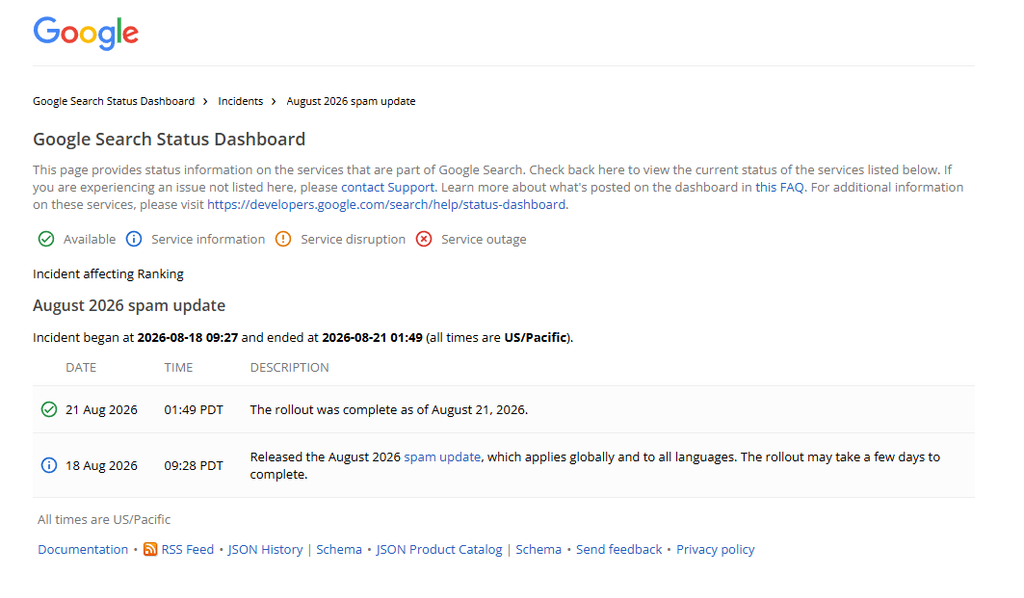
Google announced the update on 18 August and, according to its Search Status Dashboard, the rollout was complete by 21 August. It applied globally, in every language, and took just under three days.
It was the third spam update Google has released this year, following updates in March and June. No new spam policy was announced alongside it and there was no accompanying blog post explaining what had changed.
That silence is normal. Spam updates are improvements to the automated systems Google already uses to catch content that breaks its rules. They do not usually come with a target painted on them. So everything that follows about AI content comes from what people are seeing in their own data, not from Google.
The first came from an SEO who noticed that sites publishing automatically through AI tools appeared to be dropping across the board. Sites that had started life with people writing and posting by hand, then switched to automation later, seemed more likely to survive. Their theory was that the older sites had built up a track record the brand new automated ones never had. They were clear that the sample was small.
The second came from another SEO who argued that if your rankings fell between 18 and 21 August, you should look at how your content was produced before you look at how well it was written. In other words, the problem is not AI. It is using AI to churn out pages in volume.
Not everyone agreed. Some site owners said their AI written content actually did better after the update. That is worth keeping in mind. These are anecdotes, not proof.
The research behind the theory
In June, Google researchers published a paper describing a system called the Scalable Cluster Termination System, or S-CTS. It was built to catch AI spam on video platforms, but the way it works is interesting for anyone publishing text.
Rather than judging each piece of content on its own, it looks for patterns across lots of content at once: the same underlying template reused again and again with small surface changes, and publishing behaviour no human would produce, such as dozens of posts appearing on a tight schedule. The paper also mentions tools that measure how similar sentences are in meaning, not just in wording. Rewording a template does not hide it.
To be clear, Google has not said S-CTS or anything like it is used in web search. But it shows Google is thinking about AI spam at the level of patterns rather than individual pages, which fits neatly with what people reported after this update.
The part that is confirmed: Google’s scaled content abuse policy
Whatever this update targeted, the rule behind it has been public since March 2024. Google’s spam policies describe scaled content abuse as generating lots of pages mainly to manipulate rankings rather than to help people, and they say this applies “no matter how it’s created”.
The examples Google lists include using generative AI to produce many pages without adding value for readers, rewording other people’s content with synonyms or translation and stitching together bits of other pages. The same policies now also cover attempts to manipulate AI generated answers in Google Search, such as AI Overviews.
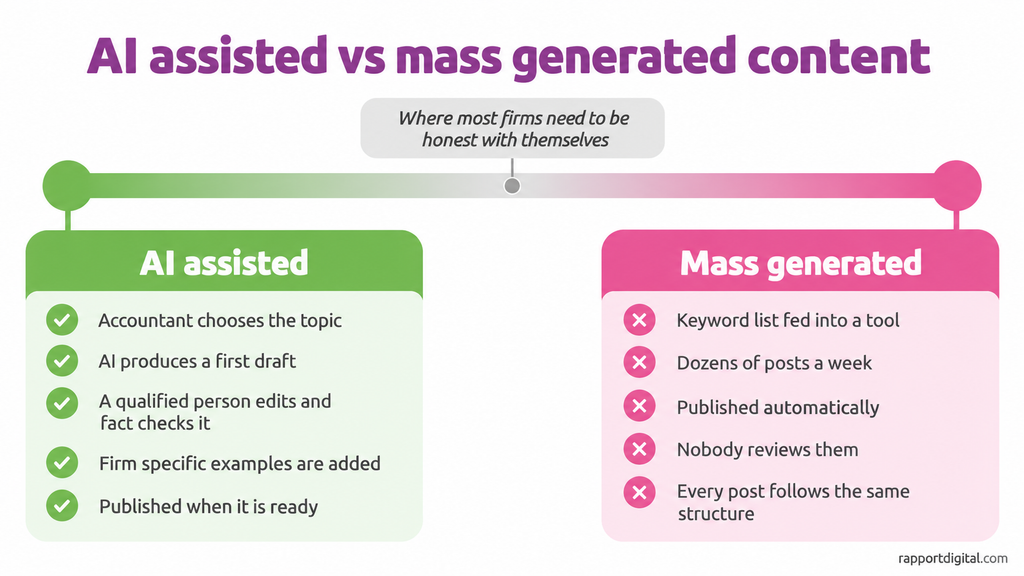
So the question Google asks is not “was this written by AI?” It is “why does this page exist?” A post an accountant planned, drafted with AI and then corrected and added to is a very different thing from fifty posts a month generated from a keyword list and published without anyone reading them.
Why accountants should pay closer attention than most
Advice about tax, compliance and financial planning falls into what Google calls Your Money or Your Life content. Google holds it to a higher standard of expertise and trust than a recipe blog or a hobby site, because bad financial advice can do real damage.
That makes generic, unchecked content a bigger risk for an accountancy firm than for most businesses. And there are three patterns we see on accountancy websites all the time that look uncomfortably similar to what this update reportedly went after.
1. The cheap AI blog package
Four posts a month for a low fixed fee, or a plugin that writes and publishes posts on a schedule. The output tends to be the same everywhere: “5 tips for your self assessment”, no named author, no view from the firm and nothing a reader could not get from GOV.UK.
The SEO risk is only half of it. AI tools still get tax thresholds, rates and deadlines wrong, and they often present last year’s figures as this year’s. Publishing that under your firm’s name is a professional risk, not just a marketing one.
2. Syndicated news feeds
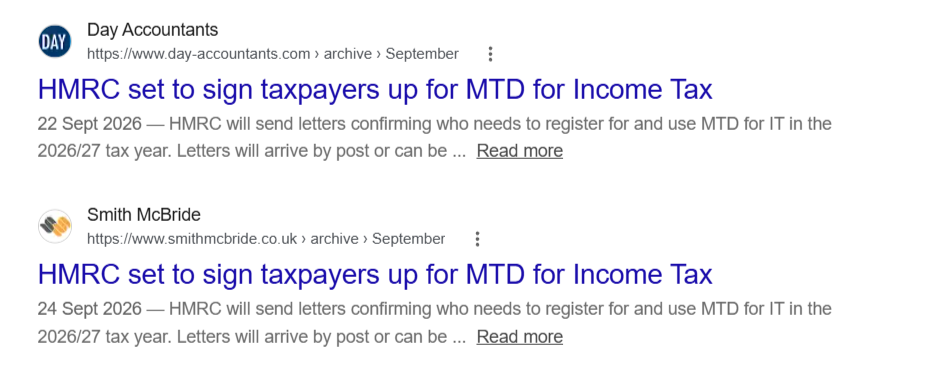
Plenty of firms subscribe to services that push the same tax news articles to hundreds of accountancy websites at once. This is not AI content and it is licensed, so it is not the same as scraping. But Google’s policies are clear that reproducing content feeds without adding anything of your own provides no unique benefit to the reader.
In practice, Google picks one version of a widely duplicated article to show, and it is rarely yours. If most of your blog is syndicated, there is nothing on it that tells Google, or a prospective client, what your firm actually knows.
3. Templated location pages
“Accountants in Bath”, “Accountants in Chippenham”, “Accountants in Frome” and twenty more, all with the same three paragraphs and only the town name swapped. Google’s spam policies specifically list pages targeted at different cities that funnel visitors to the same place, and substantially similar pages, under doorway abuse. AI has made these pages quicker than ever to produce, which is exactly why they are worth checking.
Location pages are not a problem in themselves. A page that genuinely talks about the businesses you serve in that area, your office, your team and local clients is useful. A find and replace job is not. Our local SEO guide for accountants covers how to do them properly.
How to check whether your firm was affected
The rollout finished on 21 August, so Search Console data from after that date gives you a clean read. Here is the quickest way to check.
Open Google Search Console and go to Performance, then Search results.
Click the date filter and choose Compare. Set one range starting on 22 August and an equal length range ending on 17 August.
Switch to the Pages tab and sort by the difference in clicks, so the biggest losers sit at the top.
Look at which pages dropped. If the losses are concentrated on blog posts or location pages, that is a strong clue. If the whole site fell sharply from 18 August, take it seriously.
Check Security and Manual actions, then Manual actions. Spam updates are automated, so you are unlikely to see anything here, but it takes ten seconds to rule out.
One thing to watch, because it catches accountants out: seasonality. Search interest in tax topics moves a lot through the year, with the self assessment deadline in January pulling traffic one way and the summer pulling it the other. Before you blame Google, compare the same weeks against last year as well. If a page is down on the previous month but level with last year, it is probably the calendar, not the update.
And if your traffic has been sliding gently for months rather than falling off a cliff in August, the cause is more likely something else, such as AI Overviews answering questions before anyone clicks.
What to do about it (whether you were hit or not)
Start by reviewing your content. Look at every page on your site that nobody at your firm wrote or checked. For each page, note where it came from, who it is credited to, whether a qualified person reviewed it and whether it says anything only your firm could say. Then work through what you find and…
Publish less, but make it count. One post answering a question three clients asked you this month is worth more than ten generic ones. It is also the kind of content an automated tool cannot copy.
Merge pages that cover the same ground. If you have several posts answering much the same question, combine the best parts into one strong page and redirect the others to it. One great post will do more for you than a dozen near identical ones.
Remove content that does not earn its place. If a page is out of date, inaccurate or adds nothing, take it down. Add a 301 redirect to the most relevant page so visitors and any links pointing to it are not lost.
Do not panic delete. If you were affected, change things deliberately. Google says sites that fix the problem may recover over a period of months as its systems learn the site now complies, so this is not something that bounces back overnight. Removing half your site in a rush can do more harm than good.
What this update most likely punished was publishing without thinking: pages that exist because a tool could make them, not because a client needed them. For a profession where people hand over their finances on trust, a website full of advice nobody at the firm would put their name to was always a risk. Now it may be an SEO risk as well.
Want content Google and your clients can trust?
Ourcontent writing for accountantsservice gives you blog posts and web pages written by people who understand the profession, checked for accuracy and built around your firm’s specialisms. No minimum contract and no setup fees.Book a discovery calland we will look at your current content with you.