

Backlinks are one of those SEO topics that sound a bit techy from the outside. But for accountants and financial services firms, it all boils down to your reputation.
In Google’s world, a backlink is a public vote of confidence from another website. When reputable, relevant sites link to your firm, Google takes that as a signal that you’re trustworthy and worth showing to searchers. And because accounting is a trust-first service, those signals matter a lot.
A backlink is just a link from another website to yours. If a local business blog writes “we use ABC Accountants for our bookkeeping” and links to your site, that’s a backlink. These links help you rank better, but they also send real people to your website.
Why do backlinks matter so much in your niche? Because Google has to choose which accountants to trust. In most towns there are dozens of firms offering similar services. Your website content might say all the right things, but backlinks act like third-party evidence. When other sites reference you, you look more established, more credible and more relevant for specific searches.
The good news is you don’t need hundreds of links or any dodgy tactics. You want the right links earned in ways that mirror real-world professional credibility: local authority, industry authority and proof of expertise.
The same principles apply whether you run a high street accountancy practice, a financial advisory firm or a specialist finance business. Link building for financial websites works because finance is a trust-first sector: when relevant, credible sites vouch for you, both Google and prospective clients take notice. The tactics below suit any finance or accounting firm looking to earn better backlinks.
At Rapport Digital, we know how important link building is for SEO. If you would rather have it handled for you, our link building services for accountants do exactly that. Otherwise, we are happy to share our top strategies below.
Below are beginner techniques for how to build backlinks that any firm can start with, moving into more advanced plays further down our list.
1. Ask people you know for links
This is the most overlooked starting point, and it’s surprisingly effective when done properly. You already have a network of people who trust your work. Some of them have websites. Some of them run businesses and publish blogs or resources. Others may be part of organisations that list partners or suppliers. The goal here is to turn existing relationships into simple, relevant references.
Start by listing people and organisations you already work with, such as long-standing clients, business partners (like solicitors, mortgage brokers, financial advisers, web designers), local networking contacts, software providers you’re certified with, and even friendly businesses in your area. Then ask yourself: do they have a website where it would make sense to mention an accountant?
The key is relevance. You’re not asking for random links. You’re asking for a mention where it genuinely helps their readers.
How to do it:
- Find a page on their site where your link would fit naturally.
- Send a short, low-pressure email, like: “If you ever mention your accountant on your resources or partners page, feel free to include us here. Happy to share your page too if it helps your audience.”
- If they say yes, give them the exact URL you’d like linked and a one-sentence description so they don’t have to figure out wording.
Even a handful of these warm links creates a strong base, especially if they’re from relevant local and business sites.
2. Chamber Of Commerce links
Joining your local Chamber of Commerce is a classic low-effort, high-trust link. Chambers nearly always have membership directories, and those directories often include a clickable link back to your firm.
Why it works for accountants is simple. Chamber sites are locally relevant, which is gold for local SEO. Their members are literally your potential clients: business owners and decision-makers. And a Chamber listing is a credibility signal to humans as well as Google.
How to do it:
- Join your local Chamber (or make sure you’re already listed if you’re a member).
- Claim and complete your profile. Add your core services, niches or target audience, location and service area, plus a link to your most relevant service page, not just your homepage.
- Then ask if they have additional opportunities such as member spotlights, newsletters or blog contributions. Chambers love practical advice pieces, which can often include another link.

3. Offer discounts (strategically)
Discounts aren’t just for retail brands. In professional services, a well-placed discount can earn you links from curated “deals” or “support” pages that are highly relevant to your audience.
Think about groups that naturally look for accounting support and are often listed on resource sites, such as:
- Startups and new limited companies
- Local charities and social enterprises
- Student entrepreneurs and university incubators
- Industry communities like landlord associations or contractor groups.
A small, clear discount gives these communities a reason to feature you.
How to do it:
- Create a specific offer that’s easy to describe. For example: “20% off bookkeeping for businesses under two years old.”
- Put the offer on a dedicated page on your site. That page is what people will link to.
- Pitch the offer to sites that curate help for those groups. Explain the offer, why it’s useful and share the URL.
These links are relevant, local and built around real value, which is exactly what Google wants to see.
4. Event resources
Events are a good link source because their web footprint includes organiser sites, speaker pages, sponsor pages, attendee write-ups and follow-up recaps. If you create something genuinely useful tied to a specific event or audience, you can earn links from multiple corners of that footprint.
For accountants, this works well with local business expos, landlord or property investment meetups, contractor and freelancer conferences, trade events and startup incubator programmes. The strategy is to publish a helpful resource that attendees would actually want.
How to do it:
- Pick one event your ideal clients attend.
- Create a resource page on your site. A blog post works, and a PDF download helps too.
- Email the organisers and say you’ve put together a short guide for attendees on a relevant topic, and they are welcome to include it in their resources or pre-event email if they think it’s useful.
- Share it on LinkedIn with the event hashtag and tag speakers or partners.
- If you attend, follow up afterwards with a recap post.
This works because you’re not begging for links. You’re contributing something that improves the event experience.
5. Guest blogging (selective)
If “guest blogging” is new to you, here’s what it means: you write an article for someone else’s website, and in return you usually get a short author bio and a link back to your firm.
The key word is selective. You don’t want to write for just any site. You need relevant sites your ideal clients already read such as SME blogs, local business magazines or accounting software partner blogs.
How to do it:
- Pick a niche you want more clients from, like landlords.
- Find five to ten sites that publish to that niche.
- Pitch one genuinely useful topic that fits their audience, such as “allowable expenses landlords often miss (and how to record them properly)”
- In the article, include one natural link back to a relevant guide or service page on your site.
- Keep the tone educational, not salesy. Editors want value, not adverts.
Guest posts don’t just give you links. They put your expertise in front of warm audiences and create long-term referral traffic.

6. Hire a recent graduate
This one feels unusual at first, but it can land you some very trustworthy links. Many universities actively promote alumni success, especially when a former student is doing something positive in their career.
If you’ve hired a recent graduate, or even taken on a placement student, there’s a chance the university would love to feature them (and by extension, your firm).
Even better, .ac.uk and .edu sites still carry a lot of authority, and the links tend to be genuinely editorial. You’re not buying anything or forcing a placement; you’re just being part of a real-life success story that the university wants to share.
How to do it:
- Check if the university in question runs any kind of “alumni news” or “graduate success” content.
- If they do, pitch a short story to the right person. It doesn’t need to be grand. Universities love practical angles like “From Accounting Student To Helping SMEs Thrive” or “How This Graduate Landed Their First Role In Practice.”
- If the university agrees, make sure your firm’s website is included as part of the story. Even one link like this is high trust and hard for competitors to replicate.
7. Publish “lists” content
Lists are simple to write, but incredibly easy to reference. That’s link building gold. When a blogger, journalist or business site needs a quick supporting point, they’ll often link to a list rather than a long-form narrative. In other words, lists become “source material.”
For accountants, list content works best when it reduces confusion or risk. That’s what small businesses care about. Examples that attract links include:
- “12 Allowable Expenses Contractors Forget To Claim”
- “10 Payroll Mistakes That Trigger HMRC Penalties”
- “15 Financial KPIs Every SME Should Track Monthly”
- “The 20 Most Common VAT Errors In Retail Businesses”
How to do it:
- Start with a recurring pain point you hear from clients.
- Turn it into a clear, structured list. Each item should be practical and specific, not fluffy.
- Make the post easy to cite: use short subheadings, clear explanations and small examples where relevant.
- Once it’s live, promote it to the kinds of sites that would benefit from citing it, like niche business blogs, local enterprise groups and software partners. Even if they don’t link immediately, you’ve created a resource that can quietly earn links for years.

8. Local listings
Local listings are the backbone of local SEO for accountants. They don’t feel exciting, but they reinforce your legitimacy to Google. Best of all, they often come with simple backlinks or at least citations (mentions of your business name, address, and phone number).
Beyond the obvious listings, like Google Business Profile, you should look for listings that are specific to your town, region or business community, such as:
- City or county business directories
- Local “trusted traders” or professional services listings
- Business networking group directories
- Local council or enterprise hub directories
- Industry bodies with regional member lists
How to do it:
- Search for business directories in your town. Focus on quality sites that look legitimate and actually rank or get traffic, not random junk directories.
- When you submit your listing, keep your NAP details consistent and link to a relevant service page where possible.
Over time, these links help anchor your firm to your location in Google’s map results and organic rankings.

9. Niche-specific directories
While local listings prove where you are, niche directories show what you do. A “directory of accountants for landlords” or “contractor supplier directory” is far more valuable than a generic business listing because it’s aligned with buyer intent. These links are topical, relevant and often send converting traffic.
For accountants, there are niche directories tied to:
- Industries (hospitality, construction, dental, creatives)
- Client types (landlords, contractors, startups, charities)
- Services (payroll, VAT, R&D tax credits, forensic accounting)
- Software ecosystems (Xero advisors, QuickBooks ProAdvisors, FreeAgent partner lists)
How to do it:
- Start with the niches you want more work from.
- Search for directories in that space. If you offer landlord accounting, for instance, look for landlord associations and resource hubs that list suppliers.
- When applying, don’t just drop your homepage. Link directly to the service page or guide that matches the directory’s purpose. That makes the link stronger for SEO and more useful to readers.

10. “Our partners / suppliers” pages
This tactic is about claiming links you deserve as part of existing professional relationships. Many organisations maintain pages listing trusted partners, accredited suppliers or recommended service providers. If you work with a tool, a network, or a complementary service business, you may already qualify for a listing.
For accountants, common partner-link sources include:
- Accounting software partner pages
- Payroll or HR platforms
- Finance brokers
- Law firms you refer to or receive referrals from
- Web/marketing agencies you collaborate with
- Local business networks
How to do it:
- Make a list of companies you actively work with.
- Check whether they have a partner or supplier page.
- If they do, send a quick email asking if they’re still adding partners and offering a short description.
- Keep it easy for them by including the exact URL you want linked, a one-sentence summary of your firm and any logos or accreditation details they might need
Because these links are rooted in real relationships, they look natural and carry strong trust.

11. Printable resources (PDFs)
PDFs create backlinks in a slightly indirect way. The PDF itself won’t magically earn links. What it does is make your content more shareable and more valuable. When a guide is available as a neat download, people are more likely to reference it, share it with teams or include it in resource libraries. And those libraries often link to the page hosting the PDF.
Accountants should think of PDFs as client handouts that live online. Strong PDF formats include:
- Tax deadline checklists
- Record-keeping templates
- Year-end prep guides
- Cis or VAT compliance packs
- Onboarding checklists for new limited companies
How to do it:
- Take one of your best guides and turn it into a clean downloadable version.
- Host it on a dedicated page (not just a random file link).
- On that page, explain what the PDF is for and who it helps.
- Pitch it to the same places that would benefit from distributing it: enterprise hubs, chambers, landlord groups, contractor communities and software partners.
The PDF becomes a reason to link, not the link itself.

12. Profile links
Profile links aren’t your most powerful links. But they’re easy to get, and they help you build a natural-looking link profile. They also reinforce your brand presence across the web. The key is to stick to profiles that are genuinely relevant to accounting and to your local market.
Good profile options include:
- Professional body profiles
- Local business networking profiles
- Speaker bios for events or webinars
- Finance community memberships
- Reputable industry platforms
How to do it:
- Pick a small set of platforms where your ideal clients or peers spend time.
- Complete the profile properly, add a real bio and link back to your site.
- Avoid spammy “create profiles everywhere” services. They don’t help and can look manipulative. A few clean, niche profiles are enough.

13. Sponsor events
Sponsoring events is a beginner tactic that can lead to very strong links. Even small sponsorships often come with a place on the event website. And those sponsor pages are highly relevant because they’re embedded in local or niche business ecosystems.
Events worth sponsoring for accountants include:
- Local SME meetups
- Landlord/property events
- Startup or founder programmes
- Trade association conferences
- Charity business events
How to do it:
- Find events aligned with your target audience.
- Check they have a sponsor page and that sponsors are actually listed with links.
- When you sponsor, request your link points to a relevant page, not necessarily your homepage.
- If the event is startup-focused, for example, link to your startup bookkeeping page. The closer the match, the stronger the SEO signal.

14. Sponsor venues
This is a close cousin to event sponsorship. Venues like co-working spaces, business hubs, conference centres and community venues often list ongoing sponsors or partners. These links are locally rooted, and they put your firm in front of active business communities.
How to do it:
- Look for venues where business events happen in your area.
- Check whether they have a partners or sponsors page. Many offer small sponsor packages, or they might be open to a partnership where you provide something useful like a mini workshop or a resource pack for members.
- In return, you’ll often get a link and a stream of relevant visibility.
15. Write testimonials
Testimonials are one of the easiest “earned links” because you’re helping someone else market their product. If you give a thoughtful testimonial to a service or tool you actually use, they may feature it on their site with a link back to you as proof.
This works especially well in accounting because so many tools serve your market: software providers, payment platforms, HR tools, CRM systems, banking apps and practice management solutions.
How to do it:
- List the tools and services you genuinely rate.
- Write a short testimonial that includes a specific outcome, not just generic praise. For example: “We cut onboarding time by 30% after switching to X.”
- Send it to the company’s marketing team. If they publish it, you can often ask for your firm name to be linked.
It’s a simple trade of value for value, and it’s fully within Google’s guidelines because the testimonial is authentic.

16. Calendar guides
Deadlines are a constant source of anxiety for your clients, which makes deadline content naturally linkable. A well-made accounting calendar becomes a resource other sites want to point to every year.
For UK firms, a “Tax Deadlines Calendar” can cover self-assessment, VAT quarters, payroll cut-offs, CIS returns, Companies House filing dates and any seasonal reminders that catch people out.
How to do it:
- Create a dedicated “calendar hub” page on your site, not just a throwaway blog post. Offer a downloadable PDF version too.
- Use a simple structure: month-by-month headings and clear deadlines with short explanations.
- Update it annually, but keep the URL stable so links don’t break.
- Pitch it to communities that benefit from sharing deadlines: startup programmes, landlord sites, contractor hubs, local business groups and even local press.
Once it ranks, it keeps passively earning links because people search for this stuff every year.

17. Case studies
Case studies are one of the most credible forms of content accountants can publish. They’re also extremely easy for other sites to reference because they provide concrete proof rather than abstract advice.
A strong case study doesn’t need confidential numbers. It needs a clear problem, the process you used, and the outcome.
Examples:
- A contractor who moved from chaos to a clean, tax-efficient structure.
- A landlord who reduced risk by tightening record keeping.
- An SME that improved cash flow after switching to monthly management accounts.
Related: 20 Must-Have Features Every Accountant Website Needs
How to do it:
- Pick a client success story that represents your ideal audience.
- Get permission or anonymise the details if needed, and write it like a narrative: “Here’s what was happening, here’s what we changed, here’s the result.”
- Promote it to niche sites that cover that client type. Industry sites love real examples, and they often link to case studies as proof in their own posts.

18. Charts and graphs
Visual data is link bait in the best sense. Bloggers and journalists love charts because they can embed them quickly and look smart doing it. If you publish original visuals, you increase the chance of passive backlinks without extra outreach.
For accountants, charts don’t need to be massive research pieces. They can be simple visual clarifiers.
Examples:
- A graph showing how dividend rates have changed over time.
- A chart of common VAT errors by industry.
- A visual breakdown of contractor tax bands.
How to do it:
- Take a topic clients regularly misunderstand.
- Turn it into a simple data visual, even if it’s based on publicly available HMRC stats.
- Build a blog post around it, and make the chart easy to embed by allowing downloads or offering a clear citation suggestion.
- Pitch the visual to writers who cover the topic. If they use it, they’ll usually link back.

19. Comprehensive guides and resources
While accounting topics are covered across the web, it can be harder to find a resource that’s truly definitive. The aim is to create a page that becomes the default reference point for a topic. For accountants, these work best as pillar guides, such as:
- “The Complete Guide To Contractor Tax In The UK”
- “Everything Landlords Need To Know About Allowable Expenses”
- “The Ultimate VAT Handbook For Retail And E-Commerce”
How to do it:
- Choose a topic with long-term demand.
- Build the guide to answer every major question someone might have, in a logical order.
- Add links to supporting resources and tools.
- Promote it slowly and consistently.
These pages take effort, but they’re the kind that earn links for years because other sites don’t want to recreate something so thorough.

20. Create a blog (if you don’t have one)
If your website is only a brochure with a homepage, service pages and contact page, you’ll struggle to earn links at scale. A blog gives you linkable assets. It’s how you publish calendars, lists, case studies, charts and myth-busters in the first place.
How to do it:
- You don’t need daily posts. You need consistency and usefulness. Start with one post per month, focused on a niche you want more of.
- Build clusters over time, focusing on the likes of landlords, contractors, startups and hospitality.
- Each cluster becomes a mini authority signal to Google, and each post is a potential link target during outreach.
Related: 14 Blog Posts Every Accountant Should Write & Share
21. Debunk myths
Every accounting niche has myths that spread like wildfire: “If I’m under the VAT threshold I don’t need an accountant,” or “Dividends are always better than salary.” Myth-busting posts earn links because they’re memorable, shareable and useful for anyone trying to correct misinformation.
How to do it:
- List the misconceptions clients repeat.
- Pick one per post. Explain what’s true, what’s false, and what the real-world consequence is.
- These pieces often get shared in communities, referenced by business blogs and linked when writers need a quick “actually, here’s the truth” source.

22. Event recaps
If you attend or speak at an industry event, a recap post can earn links from organisers, attendees and other content creators who want a clean summary of what mattered.
How to do it:
- Publish the recap quickly (within a week).
- Focus on actionable takeaways, not just a diary of what happened.
- Tag speakers and organisers when you share it.
- Many will link to the recap from their own follow-up resources because it saves them time.
This works especially well in niche events like landlord meetups or startup founder conferences.

23. Speak at universities (including webinars)
Universities, business schools and student enterprise programmes are always looking for practical speakers. When they announce sessions, they often link to the speaker’s business.
How to do it:
- Contact local universities, incubators or enterprise hubs and offer a useful session like “Tax Basics For Student Founders” or “What Freelancers Need To Know Before Their First Self-Assessment.”
- Ask for a listing with your site link on their event page.
- Over time, these talks also generate networking links from students and organisers who share your resources.
24. Be first to cover a story
Now we’re into advanced territory. Being first means publishing rapid, expert commentary when tax or finance news breaks. Businesses scramble for clarity, journalists scramble for quotes and slower publishers scramble for sources. If you’re fast and accurate, you become the go-to citable source.
How to do it:
- Set up alerts for HMRC announcements, Budget updates, and niche policy changes.
- When something relevant drops, publish a clear explainer within 24 hours: what changed, who it affects and what to do next.
- Send it to your newsletter, post it on LinkedIn and pitch it to local business journalists or niche publications.
- First-mover explainers often earn “reference links” for months after the news cycle ends.

25. Original data and research
If you want links from high-authority sites without constantly chasing them, original data is your best friend. Writers love citing fresh numbers because it makes their content stronger. And in accounting, there’s endless demand for trustworthy stats, especially around small business finances, tax behaviour and compliance.
You don’t need a million-respondent survey. A small, well-framed dataset in a useful niche can attract plenty of links. Here are some examples of research accountants can publish:
- A short survey of local SMEs: “What’s your biggest tax worry this year?”
- An anonymised trend piece from your client base: “Top bookkeeping errors we see in hospitality.”
- A study of public data: “How dividend vs salary strategies have shifted since [policy change].”
- A poll of contractors: “How many save for tax monthly, and how?”
How to do it:
- Pick a question your ideal clients genuinely care about.
- Gather data in a clean way. That could be a simple Typeform survey, a LinkedIn poll combined with a bigger questionnaire or analysis of public HMRC/ONS data.
- Publish the findings with clear charts, bullet-friendly stats, and a short “so what?” section explaining what it means.
- Pitch it to niche publications, local press and bloggers who cover the topic. When your data helps them make their point, they’ll link to you without much persuasion.

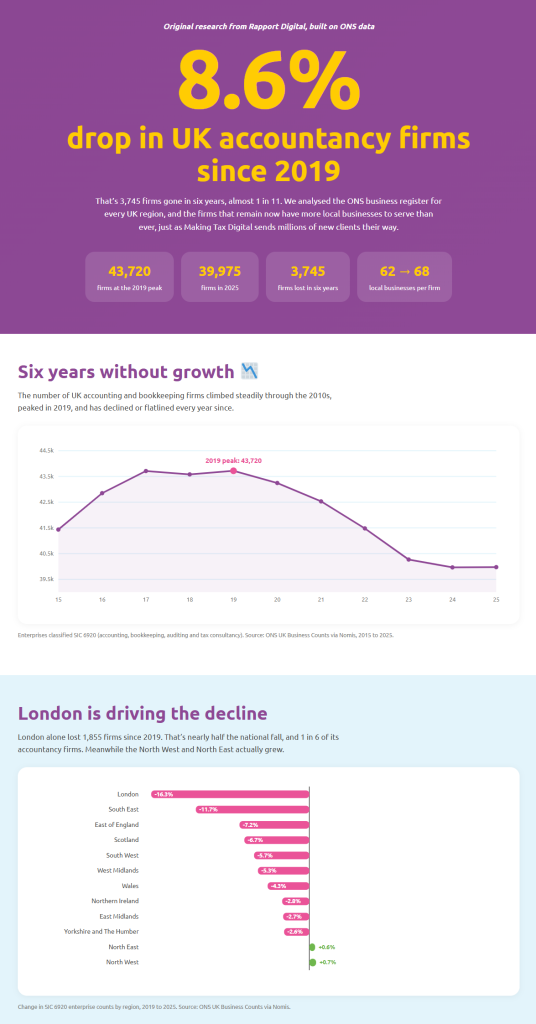
We practise what we preach. We pulled official ONS/Nomis data on UK accountancy firm numbers and turned it into a study of how the sector has changed since 2019. It surfaced genuinely newsworthy findings: the UK has lost 3,745 accountancy firms in six years, London has been hit hardest, and Making Tax Digital is about to drive a wave of new demand. See the full study, The UK Accountancy Firm Drop, and the supporting analysis on London losing 1 in 6 of its firms, the UK losing 3,745 firms since 2019, why Northern Ireland is the best place to be an accountant, and the supply and demand gap. This is data-driven link building in action, and if you want us to run the same play for your firm, see our accountancy link building services.
26. Get your own column
Guest blogging is useful, but a column is a different league. Instead of one-off appearances, you become a regular contributor on a respected site. That means predictable monthly links, a long-term credibility boost and a footprint Google can’t ignore.
Where accountants can secure columns:
- Local business news sites
- Contractor and freelancer platforms
- Landlord magazines and associations
- Industry trade publications (hospitality, construction, creative industries)
- Accounting software partner blogs
How to do it:
- Start by guest posting once to prove your usefulness.
- When the post performs, pitch a recurring slot: a monthly “tax clarity” feature, a quarterly compliance update or a regular Q&A column.
- Keep it audience-focused rather than firm-focused. The more you help their readers, the more the editor will keep you around.
- Over time, this becomes a reliable link engine that also drives high-intent enquiries.
27. Host your own events
Hosting your own events flips you from “participant” to “authority.” When you run something useful (even a small webinar), you create multiple natural reasons for people to link to you.
Links can come from:
- Event listing pages
- Community calendars
- Speakers’ sites if you host guests
- Attendee recap posts
- Local press if the event is newsworthy
What counts as an event:
- A free quarterly tax webinar for SMEs
- A landlord record-keeping workshop
- A local founders’ breakfast on cash flow
- An online session for contractors on staying compliant
How to do it:
- Pick a niche and a pain point.
- Create a dedicated event page on your site (this is your link target).
- Promote through your network, local business groups and LinkedIn.
- If you bring in a guest, they’ll often share and link to the page too. That could be a solicitor, broker or software partner.
- Afterwards, publish a recap and slides. One event can generate multiple links plus a bank of future content.

28. Speak at conferences
Speaking is one of the fastest routes to authority links. Conference websites list speakers with bios and backlinks. Attendees often write takeaways and link to speakers they learned from. Industry newsletters summarise events and link to talks. In short, one talk can spark a small cluster of links.
How to do it:
- Start with niche or regional events like landlord shows, contractor conferences, startup fairs and local business summits.
- Pitch a topic that’s immediately practical, like “How to stay tax-ready all year” or “Common VAT traps in e-commerce.”
- Once you’re confirmed, ask for your website to be linked in the speaker listing.
- After you speak, share your slide deck or summary on your site and send it to organisers and attendees. It makes their recap easier, and links often follow.

29. Badges and awards
Awards sound flashy, but they work because they trigger pride and sharing. If you create a small, credible awards programme in a niche, winners will display the badge on their sites with a link back to you.
Accountant-friendly award angles include:
- “Financially Fit SME Awards 2026”
- “Best-Run Payroll Teams in [Region]”
- “Startup Finance Excellence List”
How to do it:
- Create an awards page explaining the criteria and winners.
- Design a simple badge and include an embeddable snippet with a link to your awards page.
- Send winners the badge and encourage them to display it.
- Keep the awards genuine, niche and useful rather than grandiose. Smaller, specific awards often get more uptake because they feel personal.
30. Unlinked brand mentions
Once your firm is visible enough, people will mention you without linking. That’s free SEO value waiting to be claimed. This is one of the easiest advanced tactics because you’re not asking for a favour. You’re just requesting a small correction.
How to do it:
- Set up alerts for your firm name, partners’ names and any branded resources you’ve published.
- When you find a mention without a link, email the author politely. Thank them for including you, point out that a link would help readers find the resource, and share the correct URL.
- Most people say yes because it improves their page too.
31. Competitor link research
Your competitors’ backlinks are a map of what already works in your market. If three local firms are all getting links from the same landlord directory, that’s not a coincidence. It’s a channel you should be in too.
How to do it:
- Use a tool like Ahrefs or Semrush to look at competitor referring domains.
- Don’t obsess over the biggest firms only. Look at firms that rank for the services you want to grow.
- Identify patterns: local citations, niche directories, guest posts, partner pages, press coverage.
- Build a list of realistic opportunities and work through them systematically. You’re not copying content. You’re replicating proven visibility routes.
32. White papers
White papers are still powerful in finance because decision-makers love structured, sober insight. They sit between a blog post and a research paper. Deeper than a blog, yet easier to digest than a full report.
Examples include:
- “A Practical Guide To Tax Efficiency For Contractors”
- “The Landlord’s Compliance Playbook”
- “Cash Flow Systems That Keep SMEs Stable”
How to do it:
- Pick a topic with clear business value.
- Write it in a calm, evidence-led tone. Include frameworks, checklists, and example scenarios.
- Host it on your site with a landing page and optional PDF download.
- Pitch it to partners, business newsletters, professional bodies and niche publications.
White papers earn links slowly, but the links they earn tend to be high trust and highly relevant.

Ready to build backlinks that bring better clients?
Rapport Digital runs an SEO backlink service for accountants that earns the kind of links that actually move the needle. Think trusted, relevant mentions that lift rankings and bring in better-fit clients.
Whether you need a link-worthy content strategy, data-led resources that attract natural citations or outreach support to build authority in your niche, we’ll create a plan that fits your firm and your market.
If you’re done with guesswork and want a backlink profile that builds trust year after year, let’s make it happen. Get in touch for a free SEO and content review, and we’ll show you where the quickest wins (and biggest opportunities) are.
Let’s take your SEO to the next level. Book a free, no-pressure consultation today.